
VACANCY FALLS TO LOWEST LEVEL SINCE THE LOCKDOWN
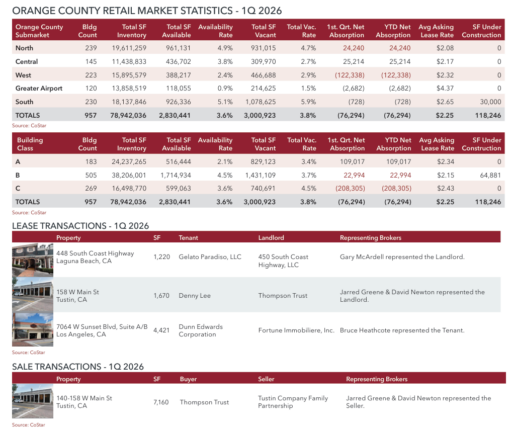
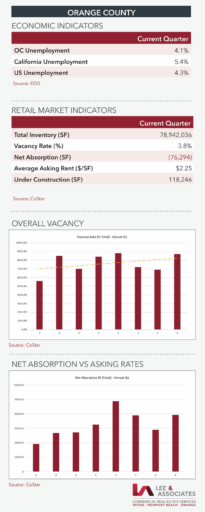 The countywide vacancy rate fell in the first quarter to 3.8%, the lowest level since the Covid lockdown five years ago. Available space in Q1 hit a near-decade low of about 2.8 million SF, or 3.6% of the 78.9-million-SF inventory. Sublet space in Q1 fell to 92,364 SF, down from 418,627 SF in the last two years.
Well-located vacancies fill quickly. Institutional-quality space is tight, and most prime corridors are near full occupancy. The strong merchant demand reflects the county’s diverse economy and a stable population with the purchasing power from a $120,000 median household income and more than 4% wage growth.
Vacancy rates across the county’s five submarkets range from 5.9% in South County to 1.5% in the Greater Airport submarket where availability totals 118,055 SF or 0.9% of the 13.9-million-SF inventory. Rents in the Airport area also were highest, averaging $4.37 per SF, and were lowest in North County, averaging $2.08 per SF.
In the West County submarket about 1.2 million SF were removed from inventory in the first quarter. More than 360,000 SF were vacated at the Westminster Mall, including Macy’s and JCPenney as redevelopment plans advance for the mall’s transformation with housing, hotel and 220,000 SF of retail space with food hall.
Demand from fitness and entertainment operators also remains strong and all second-generation restaurant spaces attract intense user interest.
Recent move-ins include Panda Mart, a South African-based discount retailer opening its first U.S. location at The Village at Orange. Ross Dress for Less opened a 49,000-SF store, and dd’s Discounts opened 25,000 SF at Santa Ana’s Bristol Marketplace.
There were 330 sales transactions in 2025 with sales volume doubling from the previous year to $1.6 billion. Much of the increase was due to the $357-million purchase of five Class A South County properties last July by Florida-based Regency Centers, which owns 485 retail projects of more than 59 million SF nationwide.
Cap rates for fast-food properties averaged 4.5% in 2025. For trades larger than $10 million, cap rates averaged about 6%.
MARKET FORECAST
The war with Iran, rising fuel costs, persistent inflation and interest rates were seen by local business leaders as the biggest challenges facing area companies, according to a Q1 survey by economists at Cal State Fullerton. Other concerns included housing, government deficits, AI and stock market volatility. Tariffs are seen as less of an issue, the survey said.