STRONG DEMAND CONTINUES; LOW AVAILABILITY AND HIGH RENTS
Strong demand for space continued in the third quarter, with the rates of vacancy and available space at all-time lows while Orange County rents remain among the highest in the nation.
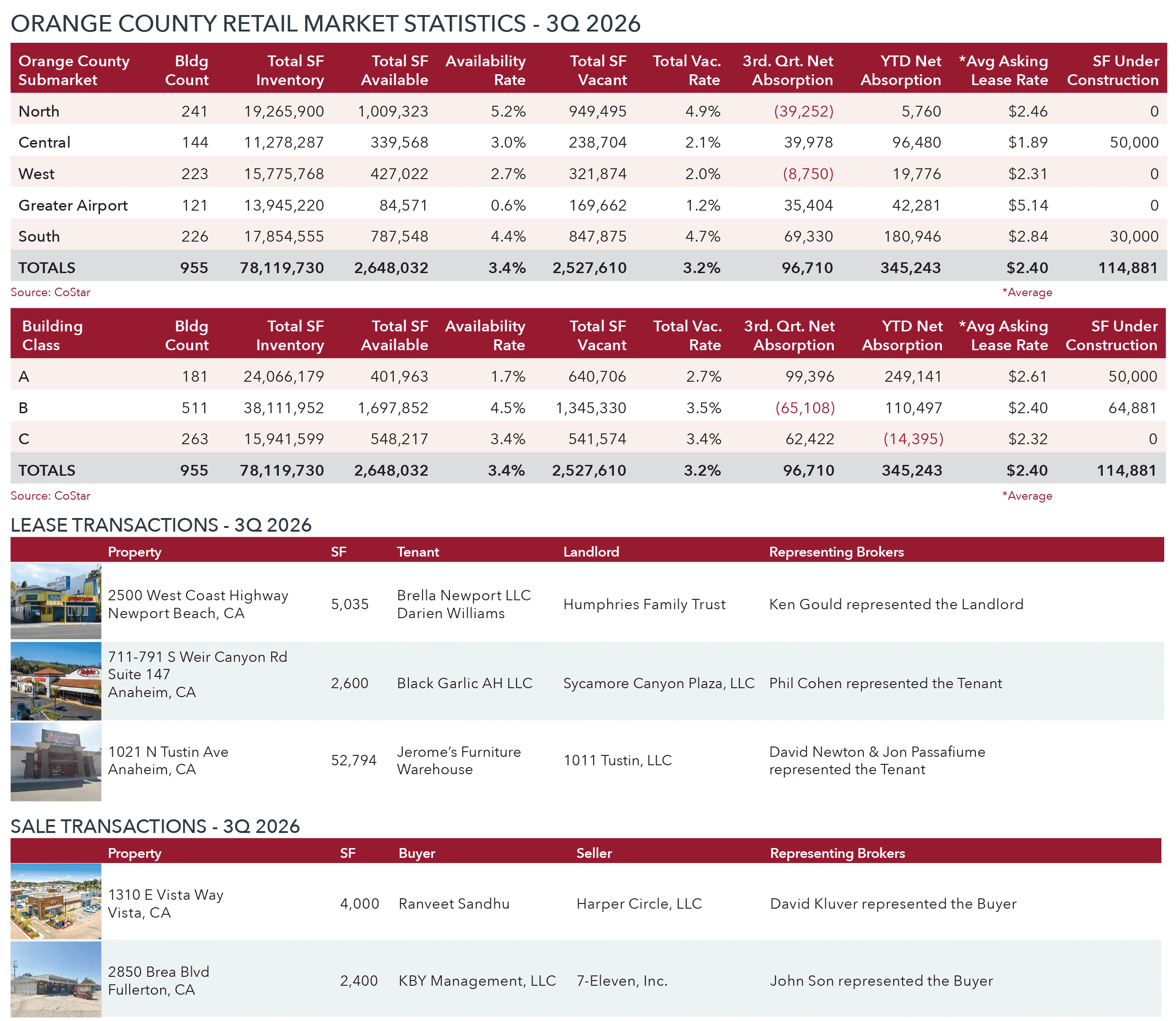
Healthy growth among merchants and entertainment providers also pushed third-quarter occupancy to a record 75,592,120 SF or 96.6% of the 78,119,730-SF base inventory.
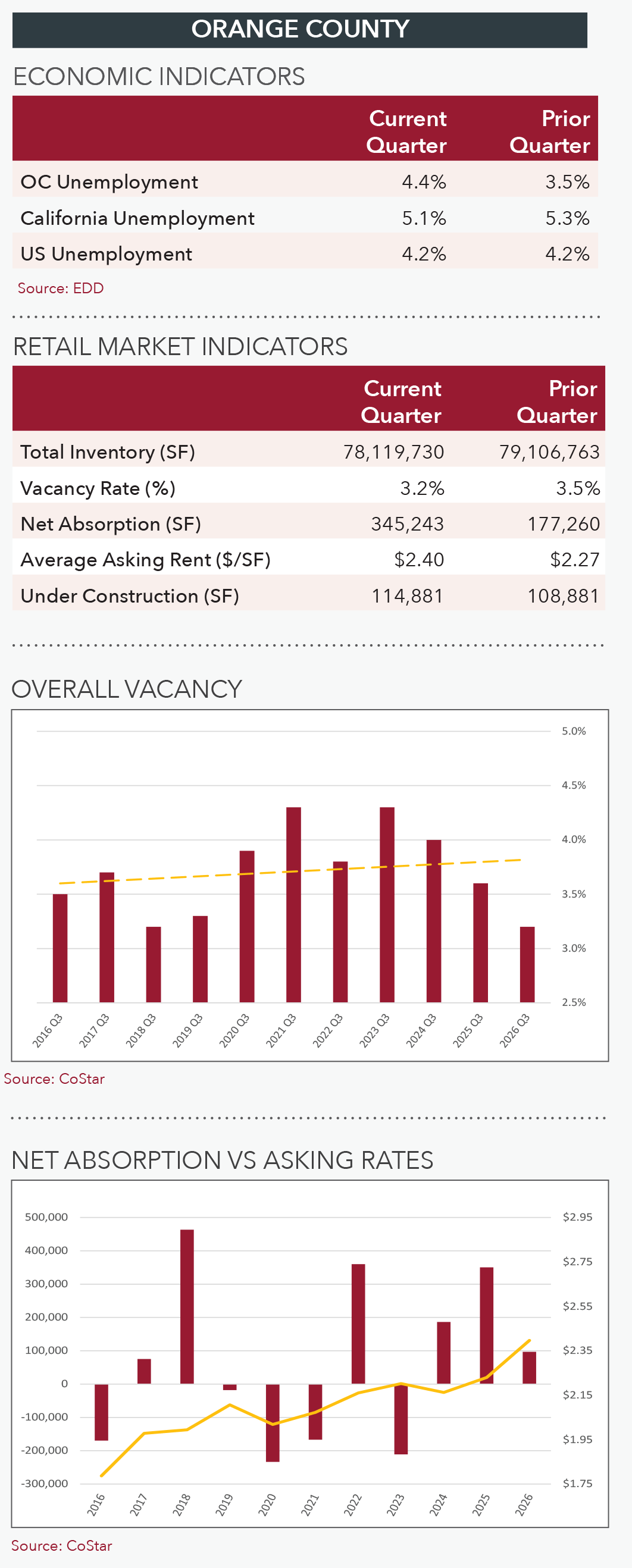
Third-quarter net absorption totaled 96,710 SF, bringing year-to-date retail expansion to 345,243 SF with most tenant demand occurring in the county’s South and Central submarkets. Countywide Q3 vacancy and availability rates each settled at 3.2%.
The market’s tight availability rate reflects consistent demand and a constrained supply base given its dense population. Land scarcity limits development and supply risk is low with only a few small projects underway. Competition for well-located space remains strong, and spaces are leasing at a median of less than seven months.
Currently, only three developments totaling 114,881 SF are under construction. Demolitions are outpacing deliveries for the seventh straight year. With little new supply in the pipeline, vacancies are likely to remain tight.
Asking rents in Orange County are the seventh highest in the nation just behind Palm Beach, Florida, averaging $2.40 per SF in the third quarter. Five California markets are among the 10 priciest in the country. In the six years since Covid, countywide rents are up nearly 19%.
Rents vary widely and typically range from $1.50 to $5.50 per SF triple net, depending on location, building type, size and overall quality.
But rent growth, particularly in priciest coastal and central submarkets, recently has tapered off as slower local household income and retail sales growth tempers retailers’ willingness to absorb continued rent hikes.
A number of retailers also are weighing the merits of becoming owner-users by acquiring stand-alone buildings that may come available as legacy merchants – such as home furnishings and consumer electronics stores – increasingly are weakened in a struggle against online sellers. Buildings used for light manufacturing also present opportunities for retail use in gentrifying neighborhoods.
Single-use buildings can range from 2,000 SF to 15,000 SF as space for restaurants to drug stores. Qualified buyers can utilize Small Business Administration loans for their acquisitions.
Meanwhile, landlords continue to seek tenants like fitness centers and other experiential tenants that drive greater foot traffic. In Orange County, for example, pickleball court operator Picklr signed leases for more than 40,000 SF in Yorba Linda and Fountain Valley.
MARKET FORECAST
As long as store openings continue to outpace closures and backfilling remains strong, the retail sector should sustain healthy leasing performance even in slowing economic growth.